Report: First International Coética Forum for Peace and Humanitarian Action
“Coética: Towards Peace and Ethical Coexistence in a Plural World” Barcelona (online) • Friday, 15 May 2026
ACTIVIDADESPROGRAMAS
Full forum video:

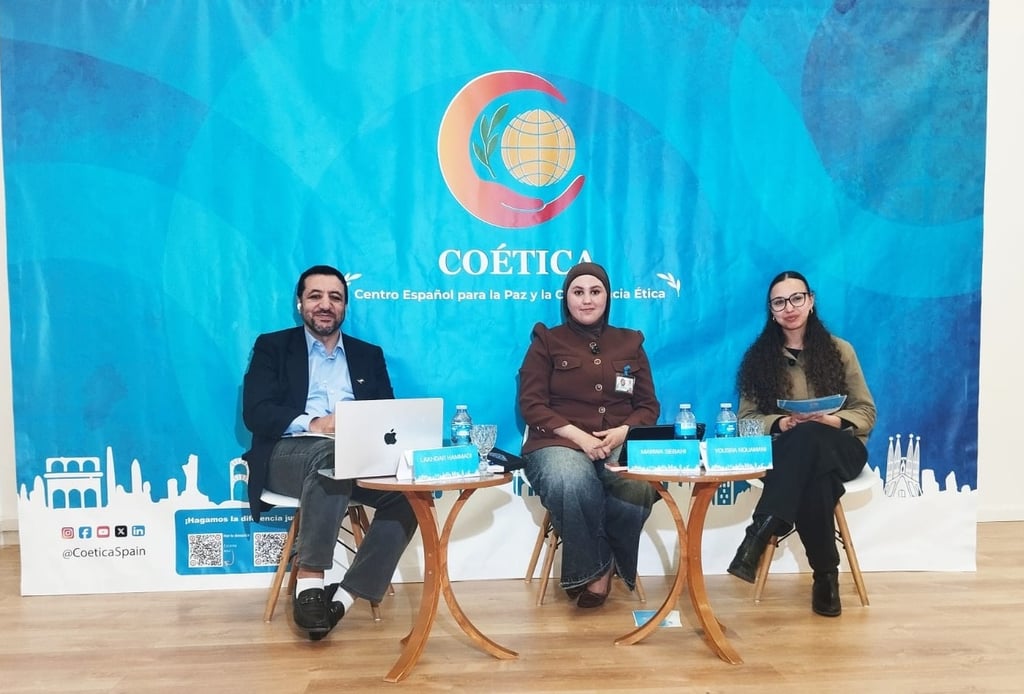
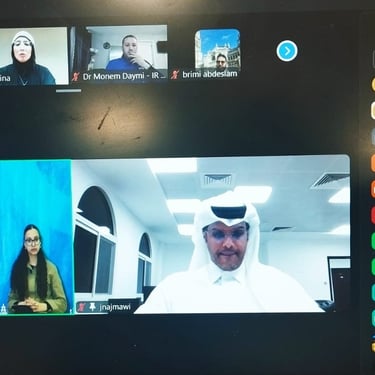
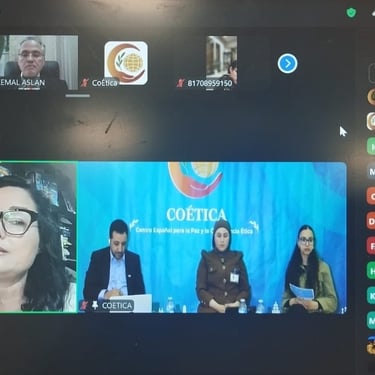
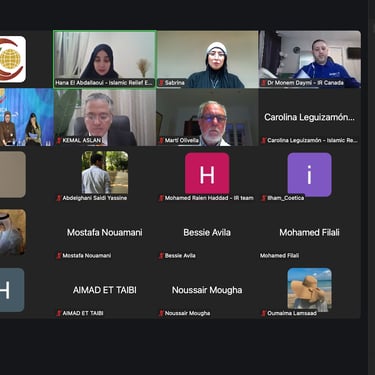
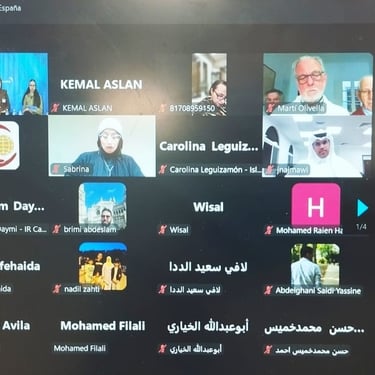
The Coética Centre hosted, on Friday 15 May 2026 from its headquarters in Barcelona, the First International Coética Forum for Peace and Humanitarian Action. The event was held entirely online via Zoom, between 19:00 and 21:30 (Madrid time). It attracted remarkable participation: more than one hundred attendees connected from twenty countries, including researchers, activists, and humanitarian organisations from Europe, North Africa, the Gulf countries, the Arab Mashreq, West Africa, Asia, and North America. The session was moderated by Marwa Sebahi, a Law student in Spain and member of the Coética Catalonia team.
“Coética”: an ethical alliance, not a mere exercise in tolerance
The forum was opened by Dr Lakhdar Hammadi, President of the Coética Centre and initiator of the project, who presented the central concept underpinning the Centre’s work: the notion of “Coética”. Through this concept, he called for moving beyond discourses of minority identity, tolerance, and even the legal framework of citizenship, towards what he called the “Co-ethical alliance”: “an ethical pact between beings who share existence and commit to building it together.” The proposal received wide support from other speakers and participating institutions, as a new formulation responding to the exhaustion of classical political vocabulary.
The initiator grounded this approach in a dual reading of the term itself. In its Latin formulation, “coética” is composed of the prefix “co-”, expressing communion, cooperation, and interaction, and “ethics”, derived from the ancient Greek ἦθος (êthos), referring to character, custom, and the system of values defining a community or culture. In its Arabic formulation, “al-Mujālaqa” (المخالقة) follows the morphological pattern of mufāʿala—expressing reciprocity—and brings together three interconnected meanings: creation (khalq), linked to the dignity of the human being (in Islam through the verse “We have honoured the children of Adam”; in Christianity through the notion of Imago Dei; and in Kantian philosophy through the idea of human duty); ethical character (khuluq), corresponding to the Greek root of “ethics”; and reciprocal action between two subjects, embedded in the very morphological structure of the term (jālaqa, yujāliqu, mujālaqa).
Thus, the Latin “coética” and the Arabic “mujālaqa” converge from two distinct civilisational horizons to express the same meaning and share a common foundation. And since language is not only a carrier of meaning but also of a civilisation’s philosophy, the pairing of both terms—emerging from distant roots without one negating the other—constitutes in itself the first outcome of the “human commonality” proposed by the Centre: an early embodiment of the idea at the level of language itself, before its translation into practice.
Over five centuries, Dr Hammadi traced this alliance through five milestones that carried the idea across civilisational shores: from the “Pact of the Virtuous” (Hilf al-Fudul) in Mecca in 580 CE, to the “Constitution of Medina” in 622 CE; from the “Pax Dei” and “Treuga Dei” in medieval France, to the project of the Abbé de Saint-Pierre for a perpetual European peace in 1713; and finally to Kant’s “Perpetual Peace” project in 1795, from which the United Nations system emerged after the Second World War. Five carefully selected milestones, one idea: the logic of the human common good.
At the practical level, Hammadi summarised the “Co-ethical Methodology” in two core principles: “the nearest first” (ethical interaction begins with one’s immediate surroundings before extending to distant humanity) and “acting, not merely observing” (commitment is a condition; those who only watch remain outside the method). From these principles emerge three pathways: the dissemination of peace; the rescue of lives in both material and moral dimensions; and community development from within.
“Coética does not open a migration file, nor is it reduced to an Islam–West duality, nor is it a minority issue. It is a deeper and broader necessity: the transition from the legal contract to the ethical alliance. Its path is ‘the nearest first’, and its motto is ‘acting, not observing’.” — Dr Lakhdar Hammadi
Martí Olivella: from disarmament to nonviolent civil defence
Catalan researcher and activist Martí Olivella highlighted the need to move beyond the doctrine of “just war”, after more than 180 million deaths caused by twentieth-century conflicts. He recalled the shared “Golden Rule” across religions—“do not do to others what you would not wish done to you”—the Human Fraternity Document signed in 2019 by Pope Francis and the Grand Imam of Al-Azhar, and the recent call by Pope Leo XIV for a “disarmed and disarming peace”. He proposed the creation of civilian networks trained in nonviolent defence, capable of rendering military options not only unnecessary but unfeasible.
“Nonviolence is not idealism: it is coherence with the oldest and most universal moral consensus of humanity. We will only abolish war if we offer an alternative to armies: an organised people capable of making any aggression impossible, ungovernable, and costly.” — Martí Olivella
Kemal Aslan: when values become social structure
From Doha, Dr Kemal Aslan, Professor of Philosophy of Ethics at Qatar Community College, offered an analysis of the relationship between ethical values and social cohesion in times of crisis. He used the initiative “Qatar minna wa nahnu minha” (“Qatar is ours and we belong to it”) as a practical example of what he called “ethical citizenship”, which binds citizens and residents in a pact of mutual recognition, loyalty, and compassion. He also cited the Qur’anic verse “We created you into peoples and tribes so that you may know one another”, emphasising that diversity is a condition for mutual understanding rather than a source of conflict.
“Ethics in Islam is not an intellectual luxury: it is the very foundation of civilisation and stability. Diversity is not a cause of conflict, but a space for mutual knowledge and complementarity.” — Dr Kemal Aslan
Inma Garro: the classroom as a laboratory of coexistence
Dr Inma Garro, Professor of Arabic Studies at the University of Alicante, brought the discussion into the heart of the Spanish education system. She presented concerning data: only 37% of children from migrant families reach higher education, compared to 61% of the native population. She called for the structural inclusion of intercultural mediators in schools and for an approach that integrates linguistic and cultural diversity—including Amazigh identity—into the educational narrative, ensuring that every student can reclaim their name, language, and sense of self.
“Diversity does not begin or end when someone crosses a border; it is present in surnames, in the languages spoken at home, in the cultural memory that accompanies each person.” — Dr Inma Garro
Faisal Al Fehaida: from values to programmes
Faisal Rashed Al Fehaida, President of the Al-Aqraboon Centre (Qatar Charity), shifted the discussion from theory to practice. He proposed an operational definition of values as “clear principles, repeated behaviours, support mechanisms, and impact indicators”, presenting the experience of the Al-Aqraboon Centre in translating values such as dignity, ihsan (excellence), and shared responsibility into measurable volunteering and educational programmes. He also reaffirmed volunteering as a “practical platform of trust” rooted in local realities before expanding outward.
“Values remain alive not by being celebrated, but by being translated into programmes; they bear fruit when grounded in human dignity and sustained by trust and partnership.” — Faisal Al Fehaida
Three programmes, one shared ground
The second part of the forum focused on the presentation of three operational programmes. Monem Daymi and Carolina Leguizamon, from Islamic Relief Canada, presented the INSPIRE programme, which since its launch has sent 1,218 Canadian volunteers to fourteen countries and raised over 6 million Canadian dollars. They summarised its philosophy:
“Our volunteers do not go as saviours, but as learners. And they do not only bring peace to the world—they bring it back home with them.” — INSPIRE Programme / Islamic Relief Canada
From Madrid, Hana Abdallaoui, Director of Islamic Relief Spain, presented the organisation’s work linking international humanitarian action with local grassroots efforts, particularly its response to the DANA disaster in Valencia.
“Spain is the country of the three cultures: eight centuries of coexistence cannot be ignored. Peace is not built only abroad; it is also built in the neighbourhood, in the parish, in the street.” — Hana Abdallaoui
As a closing contribution, Yousra Nouamani, member of the Coética Spain team, presented the “Hacedores” (Doers) programme, designed for young people who “do not lack values or energy, but tools”. It offers a three-stage pathway: a TED-style speaking platform, fifty hours of certified volunteering, and a permanent network under the name “Coética Spain–Europe”.
“Values alone are not enough if they are not turned into skills; skills do not bear fruit if they are not embodied in projects; and projects do not create change if their impact is not measured. That is Hacedores: form, serve, connect.” — Yousra Nouamani
Public reception of the forum
Participants expressed a high level of satisfaction, with an average rating of 4.63 out of 5. More than 94% of respondents rated the forum as “good” or “excellent”. Comments highlighted the “quality of organisation” and “relevant content”, with repeated calls to extend future editions and allocate more time to debate and questions.
Horizons
The organising committee announced, at the close of the session, the launch of the Coética Journal as an editorial and theoretical platform to follow up the debates, while the second edition of the forum is expected to deepen the practical applications of the “Co-ethical Methodology” and expand the network of associated local and international centres and organisations. Dr Hammadi concluded with a reflection that captures the spirit of the initiative:
“We need a good dose of imagination, a good dose of hope, and a good dose of certainty. The future is made by dreamers—in the positive sense of dreaming.”
CoÉtica
Spread peace and live with ethics
contact
Integración
contact@coetica.org
+34 747465698
© 2026. All rights reserved.